 b802889ef0
* - Use staged container builds to improve caching and reduce size
- Image size reduced from 8 GB to 1.6ish
- Switched from Make to Ninja for faster builds that do not hog processor
- Removed unneded dependencies
- Added to .dockerignore
- Readme for docker stuff

- Staged Builds
    - Docker's overlay FS means that `rm`ing files does not reduce size
    - Once build artifacts are build, the build dependencies are no longer needed
    - Both of these can be solved by building in a temporary image and copying
    only the needed libraries in
    - Leverages DESTDIR to generate a directory structure that can be just
    copied onto the `/` of the filesystem
    - Similarly, the data files (like models) can be downloaded ahead of time
    into their own image and copied in. This saves on network IO.
    - Anything in a RUN directive that is non-deterministic (e.g. downloading
    a file from a link, the content of that link changes) does not cause a cache
    miss, so if you need to update something RUN uses, either modify the
    dockerfile or build with `--no-cache` to force a rebuild
- Switch to Ninja
    - cmake can generate many types of build systems
    - Ninja builds faster than GNU Make
    - `make -j` has a tendency to lock up my system when building locally
    - Do not need to tell ninja how many jobs to run
- .dockerignore
    - Paths in .dockerignore are basically invisible to dockerd, so when dockerd
    zips up the build context, all of the cruft can be ignored
    - it is beneficial to docker build speed to add any large, unnecssary files
    and directories to .dockerignore.
    - Just remember they cannot be seen by dockerd

* removing cruft and some format fixes

* updated dockerfile to opencv 4.1.0
OpenFace 2.1.0: an open source facial behavior analysis toolkit

Over the past few years, there has been an increased interest in automatic facial behavior analysis and understanding. We present OpenFace – a tool intended for computer vision and machine learning researchers, affective computing community and people interested in building interactive applications based on facial behavior analysis. OpenFace is the first toolkit capable of facial landmark detection, head pose estimation, facial action unit recognition, and eye-gaze estimation with available source code for both running and training the models. The computer vision algorithms which represent the core of OpenFace demonstrate state-of-the-art results in all of the above mentioned tasks. Furthermore, our tool is capable of real-time performance and is able to run from a simple webcam without any specialist hardware.


OpenFace is an implementation of a number of research papers from the Multicomp group, Language Technologies Institute at the Carnegie Mellon University and Rainbow Group, Computer Laboratory, University of Cambridge. The founder of the project and main developer is Tadas Baltrušaitis.
Special thanks goes to Louis-Philippe Morency and his MultiComp Lab at Carnegie Mellon University for help in writing and testing the code, Erroll Wood for the gaze estimation work, and Amir Zadeh and Yao Chong Lim on work on the CE-CLM model.
WIKI
For instructions of how to install/compile/use the project please see WIKI
Functionality
The system is capable of performing a number of facial analysis tasks:
- Facial Landmark Detection

- Facial Landmark and head pose tracking (links to YouTube videos)
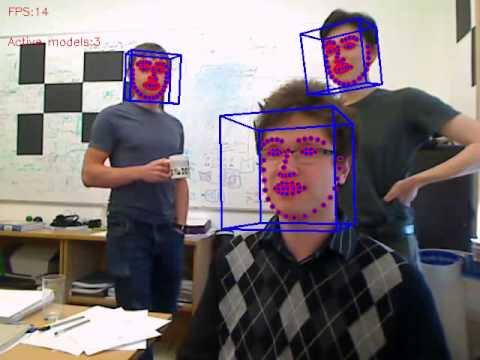
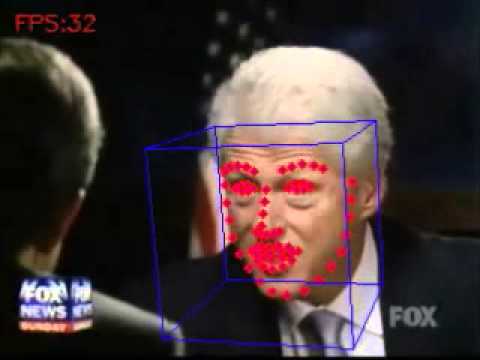
- Facial Action Unit Recognition

- Gaze tracking (image of it in action)

- Facial Feature Extraction (aligned faces and HOG features)

Citation
If you use any of the resources provided on this page in any of your publications we ask you to cite the following work and the work for a relevant submodule you used.
Overall system
OpenFace 2.0: Facial Behavior Analysis Toolkit Tadas Baltrušaitis, Amir Zadeh, Yao Chong Lim, and Louis-Philippe Morency, IEEE International Conference on Automatic Face and Gesture Recognition, 2018
Facial landmark detection and tracking
Convolutional experts constrained local model for facial landmark detection A. Zadeh, T. Baltrušaitis, and Louis-Philippe Morency. Computer Vision and Pattern Recognition Workshops, 2017
Constrained Local Neural Fields for robust facial landmark detection in the wild Tadas Baltrušaitis, Peter Robinson, and Louis-Philippe Morency. in IEEE Int. Conference on Computer Vision Workshops, 300 Faces in-the-Wild Challenge, 2013.
Eye gaze tracking
Rendering of Eyes for Eye-Shape Registration and Gaze Estimation Erroll Wood, Tadas Baltrušaitis, Xucong Zhang, Yusuke Sugano, Peter Robinson, and Andreas Bulling in IEEE International Conference on Computer Vision (ICCV), 2015
Facial Action Unit detection
Cross-dataset learning and person-specific normalisation for automatic Action Unit detection Tadas Baltrušaitis, Marwa Mahmoud, and Peter Robinson in Facial Expression Recognition and Analysis Challenge, IEEE International Conference on Automatic Face and Gesture Recognition, 2015
Commercial license
For inquiries about the commercial licensing of the OpenFace toolkit please visit https://www.flintbox.com/public/project/50632/
Final remarks
I did my best to make sure that the code runs out of the box but there are always issues and I would be grateful for your understanding that this is research code and a research project. If you encounter any problems/bugs/issues please contact me on github or by emailing me at tadyla@gmail.com for any bug reports/questions/suggestions. I prefer questions and bug reports on github as that provides visibility to others who might be encountering same issues or who have the same questions.
Copyright
Copyright can be found in the Copyright.txt
You have to respect boost, dlib, OpenBLAS, and OpenCV licenses.
Furthermore you have to respect the licenses of the datasets used for model training - https://github.com/TadasBaltrusaitis/OpenFace/wiki/Datasets