
简体中文 | English
Arcface-Paddle
1. Introduction
Arcface-Paddle is an open source deep face detection and recognition toolkit, powered by PaddlePaddle. Arcface-Paddle provides three related pretrained models now, include BlazeFace for face detection, ArcFace and MobileFace for face recognition.
- This tutorial is mainly about face recognition.
- For face detection task, please refer to: Face detection tuturial.
- For Whl package inference using PaddleInference, please refer to whl package inference.
2. Environment preparation
2.1 Install Paddle from pypi
pip install paddlepaddle-gpu==2.2.0rc0
3. Data preparation
3.1 Download dataset
Download the dataset from insightface datasets.
3.2 Extract MXNet Dataset to images
python tools/mx_recordio_2_images.py --root_dir ms1m-retinaface-t1/ --output_dir MS1M_v3/
After finishing unzipping the dataset, the folder structure is as follows.
MS1M_v3
|_ images
|  |_ 00000001.jpg
|  |_ ...
|  |_ 05179510.jpg
|_ label.txt
|_ agedb_30.bin
|_ cfp_ff.bin
|_ cfp_fp.bin
|_ lfw.bin
Label file format is as follows.
# delimiter: "\t"
# the following the content of label.txt
images/00000001.jpg 0
...
If you want to use customed dataset, you can arrange your data according to the above format.
3.3 Transform between original image files and bin files
If you want to convert original image files to bin files used directly for training process, you can use the following command to finish the conversion.
python tools/convert_image_bin.py --image_path="your/input/image/path" --bin_path="your/output/bin/path" --mode="image2bin"
If you want to convert bin files to original image files, you can use the following command to finish the conversion.
python tools/convert_image_bin.py --image_path="your/input/bin/path" --bin_path="your/output/image/path" --mode="bin2image"
4. How to Training
4.1 Single node, single GPU
Dynamic Mode
# For MobileFace
sh scripts/train_dynamic_single_gpu.sh
4.2 Single node, 8 GPUs:
Static Mode
sh scripts/train_static.sh
Dynamic Mode
sh scripts/train_dynamic.sh
During training, you can view loss changes in real time through VisualDL, For more information, please refer to VisualDL.
5. Model evaluation
The model evaluation process can be started as follows.
Static Mode
sh scripts/validation_static.sh
Dynamic Mode
sh scripts/validation_dynamic.sh
6. Export model
PaddlePaddle supports inference using prediction engines. Firstly, you should export inference model.
Static Mode
sh scripts/export_static.sh
Dynamic Mode
sh scripts/export_dynamic.sh
We also support export to onnx model, you only need to set --export_type onnx.
7. Model inference
The model inference process supports paddle save inference model and onnx model.
sh scripts/inference.sh
8. Model performance
8.1 Performance of Lighting Model
Configuration:
- CPU: Intel(R) Xeon(R) Gold 6184 CPU @ 2.40GHz
- GPU: a single NVIDIA Tesla V100
- Precison: FP32
- BatchSize: 64/512
- SampleRatio: 1.0
- Embedding Size: 128
| Model structure | lfw | cfp_fp | agedb30 | CPU time cost | GPU time cost | Inference model |
|---|---|---|---|---|---|---|
| MobileFace-Paddle | 0.9945 | 0.9343 | 0.9613 | 4.3ms | 2.3ms | download link |
| MobileFace-mxnet | 0.9950 | 0.8894 | 0.9591 | 7.3ms | 4.7ms | - |
- Note: MobileFaceNet-Paddle training using MobileFaceNet_128
8.2 Accuracy on Verification Datasets
Configuration:
- GPU: 8 NVIDIA Tesla V100 32G
- Precison: Pure FP16
- BatchSize: 128/1024
| Mode | Datasets | backbone | Ratio | agedb30 | cfp_fp | lfw | log | checkpoint |
|---|---|---|---|---|---|---|---|---|
| Static | MS1MV3 | r50 | 0.1 | 0.98317 | 0.98943 | 0.99850 | log | checkpoint |
| Static | MS1MV3 | r50 | 1.0 | 0.98283 | 0.98843 | 0.99850 | log | checkpoint |
| Dynamic | MS1MV3 | r50 | 0.1 | 0.98333 | 0.98900 | 0.99833 | log | checkpoint |
| Dynamic | MS1MV3 | r50 | 1.0 | 0.98317 | 0.98900 | 0.99833 | log | checkpoint |
8.3 Maximum Number of Identities
Configuration:
- GPU: 8 NVIDIA Tesla V100 32G
- BatchSize: 64/512
- SampleRatio: 0.1
| Mode | Precision | Res50 | Res100 |
|---|---|---|---|
| Framework1 (static) | AMP | 42000000 | 39000000 |
| Framework2 (dynamic) | AMP | 30000000 | 29000000 |
| Paddle (static) | Pure FP16 | 60000000 | 60000000 |
| Paddle (dynamic) | Pure FP16 | 59000000 | 59000000 |
Note: config environment variable export FLAGS_allocator_strategy=naive_best_fit
8.4 Throughtput
Configuration:
- BatchSize: 128/1024
- SampleRatio: 0.1
- Datasets: MS1MV3

For more experimental results see PLSC, which is an open source Paddle Large Scale Classification Tools powered by PaddlePaddle. It supports 60 million classes on 8 NVIDIA V100 (32G).
9. Inference using PaddleInference
9.1 Install insightface-paddle
# install insightface-paddle
pip install --upgrade insightface-paddle
9.2 Download the index gallery, demo image.
mkdir -p images/gallery/
mkdir -p images/query/

# Index library for the recognition process
wget https://raw.githubusercontent.com/littletomatodonkey/insight-face-paddle/main/demo/friends/index.bin -P images/gallery/
# Demo image
wget https://raw.githubusercontent.com/littletomatodonkey/insight-face-paddle/main/demo/friends/query/friends2.jpg -P images/query/
9.3 Inference using MobileFace
# default using MobileFace
insightfacepaddle \
    --det \
    --rec \
    --index=images/gallery/index.bin \
    --input=images/query/friends2.jpg \
    --output="./output"
The final result is save in folder output/, which is shown as follows.
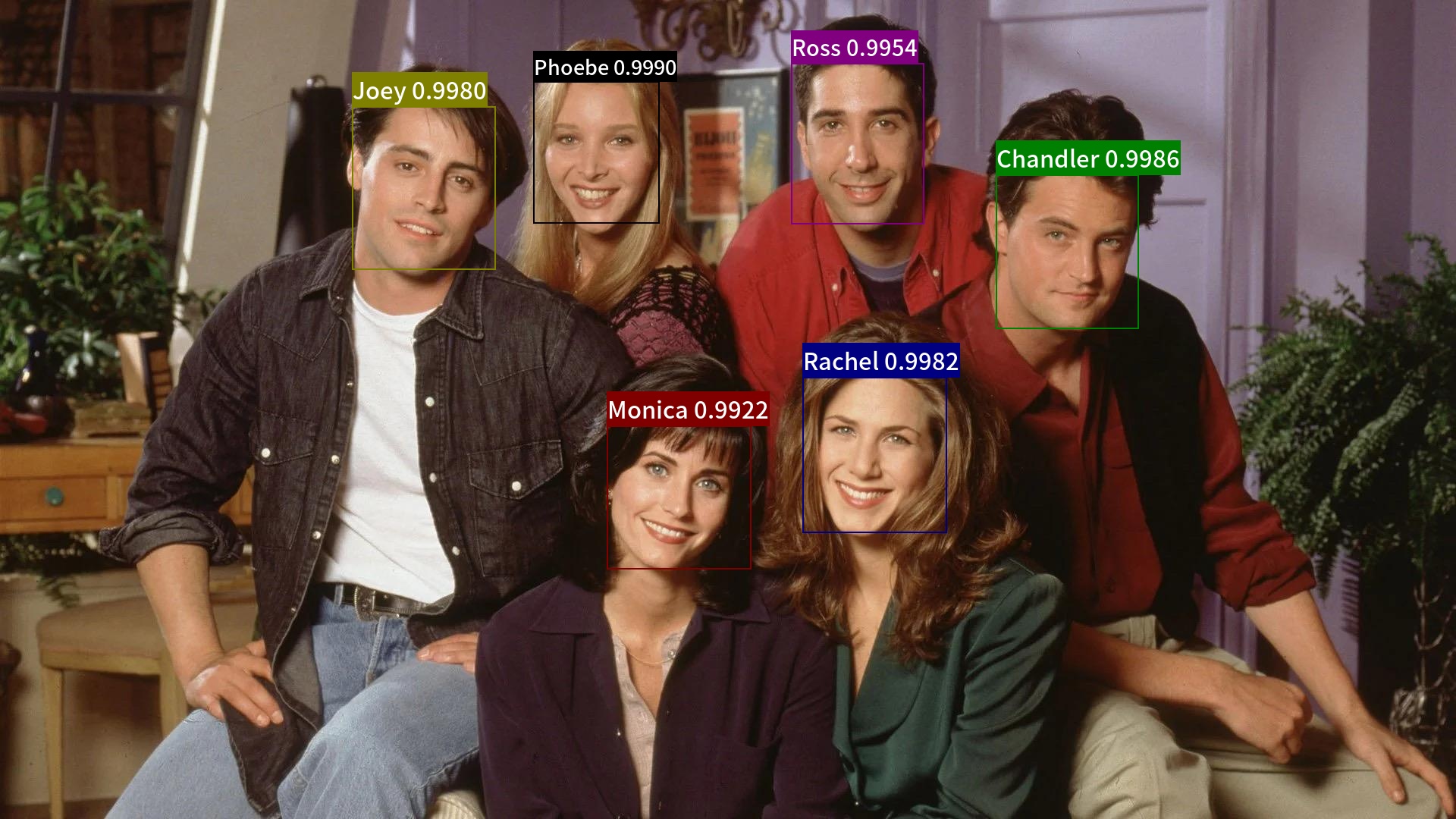
For more details about parameter explanations, index gallery construction and whl package inference, please refer to Whl package inference tutorial.