mirror of
https://github.com/yakhyo/uniface.git
synced 2026-05-15 04:37:49 +00:00

297 lines
6.8 KiB
Markdown
297 lines
6.8 KiB
Markdown
# Detection
|
||
|
||
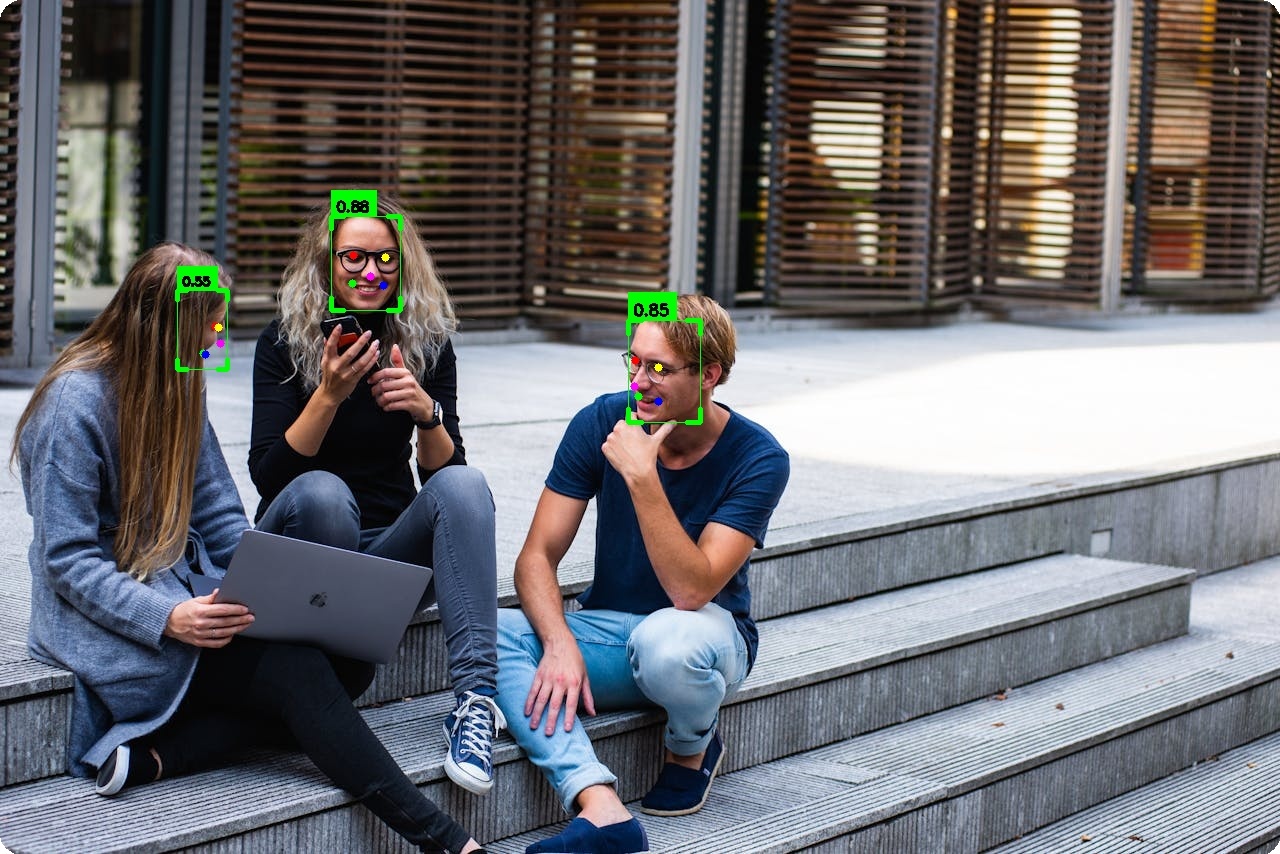
Face detection is the first step in any face analysis pipeline. UniFace provides four detection models.
|
||
|
||
<figure markdown="span">
|
||
{ width="100%" }
|
||
<figcaption>SCRFD detection with corner-style bounding boxes and 5-point landmarks</figcaption>
|
||
</figure>
|
||
|
||
---
|
||
|
||
## Available Models
|
||
|
||
| Model | Backbone | Size | Easy | Medium | Hard | Landmarks |
|
||
|-------|----------|------|------|--------|------|:---------:|
|
||
| **RetinaFace** | MobileNet V2 | 3.5 MB | 91.7% | 91.0% | 86.6% | :material-check: |
|
||
| **SCRFD** | SCRFD-10G | 17 MB | 95.2% | 93.9% | 83.1% | :material-check: |
|
||
| **YOLOv5-Face** | YOLOv5s | 28 MB | 94.3% | 92.6% | 83.2% | :material-check: |
|
||
| **YOLOv8-Face** | YOLOv8n | 12 MB | 94.6% | 92.3% | 79.6% | :material-check: |
|
||
|
||
!!! note "Dataset"
|
||
All models trained on WIDERFACE dataset.
|
||
---
|
||
|
||
## RetinaFace
|
||
|
||
Single-shot face detector with multi-scale feature pyramid.
|
||
|
||
### Basic Usage
|
||
|
||
```python
|
||
from uniface.detection import RetinaFace
|
||
|
||
detector = RetinaFace()
|
||
faces = detector.detect(image)
|
||
|
||
for face in faces:
|
||
print(f"Confidence: {face.confidence:.2f}")
|
||
print(f"BBox: {face.bbox}")
|
||
print(f"Landmarks: {face.landmarks.shape}") # (5, 2)
|
||
```
|
||
|
||
### Model Variants
|
||
|
||
```python
|
||
from uniface.detection import RetinaFace
|
||
from uniface.constants import RetinaFaceWeights
|
||
|
||
# Lightweight (mobile/edge)
|
||
detector = RetinaFace(model_name=RetinaFaceWeights.MNET_025)
|
||
|
||
# Balanced (default)
|
||
detector = RetinaFace(model_name=RetinaFaceWeights.MNET_V2)
|
||
|
||
# High accuracy
|
||
detector = RetinaFace(model_name=RetinaFaceWeights.RESNET34)
|
||
```
|
||
|
||
| Variant | Params | Size | Easy | Medium | Hard |
|
||
|---------|--------|------|------|--------|------|
|
||
| MNET_025 | 0.4M | 1.7 MB | 88.5% | 87.0% | 80.6% |
|
||
| MNET_050 | 1.0M | 2.6 MB | 89.4% | 88.0% | 82.4% |
|
||
| MNET_V1 | 3.5M | 3.8 MB | 90.6% | 89.1% | 84.1% |
|
||
| **MNET_V2** :material-check-circle: | 3.2M | 3.5 MB | 91.7% | 91.0% | 86.6% |
|
||
| RESNET18 | 11.7M | 27 MB | 92.5% | 91.0% | 86.6% |
|
||
| RESNET34 | 24.8M | 56 MB | 94.2% | 93.1% | 88.9% |
|
||
|
||
### Configuration
|
||
|
||
```python
|
||
detector = RetinaFace(
|
||
model_name=RetinaFaceWeights.MNET_V2,
|
||
confidence_threshold=0.5, # Min confidence
|
||
nms_threshold=0.4, # NMS IoU threshold
|
||
input_size=(640, 640), # Input resolution
|
||
dynamic_size=False, # Enable dynamic input size
|
||
providers=None, # Auto-detect, or ['CPUExecutionProvider']
|
||
)
|
||
```
|
||
|
||
---
|
||
|
||
## SCRFD
|
||
|
||
State-of-the-art detection with excellent accuracy-speed tradeoff.
|
||
|
||
### Basic Usage
|
||
|
||
```python
|
||
from uniface.detection import SCRFD
|
||
|
||
detector = SCRFD()
|
||
faces = detector.detect(image)
|
||
```
|
||
|
||
### Model Variants
|
||
|
||
```python
|
||
from uniface.detection import SCRFD
|
||
from uniface.constants import SCRFDWeights
|
||
|
||
# Real-time (lightweight)
|
||
detector = SCRFD(model_name=SCRFDWeights.SCRFD_500M_KPS)
|
||
|
||
# High accuracy (default)
|
||
detector = SCRFD(model_name=SCRFDWeights.SCRFD_10G_KPS)
|
||
```
|
||
|
||
| Variant | Params | Size | Easy | Medium | Hard |
|
||
|---------|--------|------|------|--------|------|
|
||
| SCRFD_500M_KPS | 0.6M | 2.5 MB | 90.6% | 88.1% | 68.5% |
|
||
| **SCRFD_10G_KPS** :material-check-circle: | 4.2M | 17 MB | 95.2% | 93.9% | 83.1% |
|
||
|
||
### Configuration
|
||
|
||
```python
|
||
detector = SCRFD(
|
||
model_name=SCRFDWeights.SCRFD_10G_KPS,
|
||
confidence_threshold=0.5,
|
||
nms_threshold=0.4,
|
||
input_size=(640, 640),
|
||
providers=None, # Auto-detect, or ['CPUExecutionProvider']
|
||
)
|
||
```
|
||
|
||
---
|
||
|
||
## YOLOv5-Face
|
||
|
||
YOLO-based detection optimized for faces.
|
||
|
||
### Basic Usage
|
||
|
||
```python
|
||
from uniface.detection import YOLOv5Face
|
||
|
||
detector = YOLOv5Face()
|
||
faces = detector.detect(image)
|
||
```
|
||
|
||
### Model Variants
|
||
|
||
```python
|
||
from uniface.detection import YOLOv5Face
|
||
from uniface.constants import YOLOv5FaceWeights
|
||
|
||
# Lightweight
|
||
detector = YOLOv5Face(model_name=YOLOv5FaceWeights.YOLOV5N)
|
||
|
||
# Balanced (default)
|
||
detector = YOLOv5Face(model_name=YOLOv5FaceWeights.YOLOV5S)
|
||
|
||
# High accuracy
|
||
detector = YOLOv5Face(model_name=YOLOv5FaceWeights.YOLOV5M)
|
||
```
|
||
|
||
| Variant | Size | Easy | Medium | Hard |
|
||
|---------|------|------|--------|------|
|
||
| YOLOV5N | 11 MB | 93.6% | 91.5% | 80.5% |
|
||
| **YOLOV5S** :material-check-circle: | 28 MB | 94.3% | 92.6% | 83.2% |
|
||
| YOLOV5M | 82 MB | 95.3% | 93.8% | 85.3% |
|
||
|
||
!!! note "Fixed Input Size"
|
||
YOLOv5-Face uses a fixed input size of 640×640.
|
||
|
||
### Configuration
|
||
|
||
```python
|
||
detector = YOLOv5Face(
|
||
model_name=YOLOv5FaceWeights.YOLOV5S,
|
||
confidence_threshold=0.6,
|
||
nms_threshold=0.5,
|
||
nms_mode='numpy', # or 'torchvision' for faster NMS
|
||
providers=None, # Auto-detect, or ['CPUExecutionProvider']
|
||
)
|
||
```
|
||
|
||
---
|
||
|
||
## YOLOv8-Face
|
||
|
||
Anchor-free detection with DFL (Distribution Focal Loss) for accurate bbox regression.
|
||
|
||
### Basic Usage
|
||
|
||
```python
|
||
from uniface.detection import YOLOv8Face
|
||
|
||
detector = YOLOv8Face()
|
||
faces = detector.detect(image)
|
||
```
|
||
|
||
### Model Variants
|
||
|
||
```python
|
||
from uniface.detection import YOLOv8Face
|
||
from uniface.constants import YOLOv8FaceWeights
|
||
|
||
# Lightweight
|
||
detector = YOLOv8Face(model_name=YOLOv8FaceWeights.YOLOV8_LITE_S)
|
||
|
||
# Recommended (default)
|
||
detector = YOLOv8Face(model_name=YOLOv8FaceWeights.YOLOV8N)
|
||
```
|
||
|
||
| Variant | Size | Easy | Medium | Hard |
|
||
|---------|------|------|--------|------|
|
||
| YOLOV8_LITE_S | 7.4 MB | 93.4% | 91.2% | 78.6% |
|
||
| **YOLOV8N** :material-check-circle: | 12 MB | 94.6% | 92.3% | 79.6% |
|
||
|
||
!!! note "Fixed Input Size"
|
||
YOLOv8-Face uses a fixed input size of 640×640.
|
||
|
||
### Configuration
|
||
|
||
```python
|
||
detector = YOLOv8Face(
|
||
model_name=YOLOv8FaceWeights.YOLOV8N,
|
||
confidence_threshold=0.5,
|
||
nms_threshold=0.45,
|
||
nms_mode='numpy', # or 'torchvision' for faster NMS
|
||
providers=None, # Auto-detect, or ['CPUExecutionProvider']
|
||
)
|
||
```
|
||
|
||
---
|
||
|
||
## Factory Function
|
||
|
||
Create detectors dynamically:
|
||
|
||
```python
|
||
from uniface.detection import create_detector
|
||
|
||
detector = create_detector('retinaface')
|
||
# or
|
||
detector = create_detector('scrfd')
|
||
# or
|
||
detector = create_detector('yolov5face')
|
||
# or
|
||
detector = create_detector('yolov8face')
|
||
```
|
||
|
||
---
|
||
|
||
## Output Format
|
||
|
||
All detectors return `list[Face]`:
|
||
|
||
```python
|
||
for face in faces:
|
||
# Bounding box [x1, y1, x2, y2]
|
||
bbox = face.bbox
|
||
|
||
# Detection confidence (0-1)
|
||
confidence = face.confidence
|
||
|
||
# 5-point landmarks (5, 2)
|
||
landmarks = face.landmarks
|
||
# [left_eye, right_eye, nose, left_mouth, right_mouth]
|
||
```
|
||
|
||
---
|
||
|
||
## Visualization
|
||
|
||
```python
|
||
from uniface.draw import draw_detections
|
||
|
||
draw_detections(
|
||
image=image,
|
||
faces=faces,
|
||
vis_threshold=0.6,
|
||
)
|
||
|
||
cv2.imwrite("result.jpg", image)
|
||
```
|
||
|
||
---
|
||
|
||
## Performance Comparison
|
||
|
||
Benchmark on your hardware:
|
||
|
||
```bash
|
||
python tools/detect.py --source image.jpg
|
||
```
|
||
|
||
---
|
||
|
||
## See Also
|
||
|
||
- [Recognition Module](recognition.md) - Extract embeddings from detected faces
|
||
- [Landmarks Module](landmarks.md) - Get 106 / 98 / 68-point dense landmarks
|
||
- [Image Pipeline Recipe](../recipes/image-pipeline.md) - Complete detection workflow
|
||
- [Concepts: Thresholds](../concepts/thresholds-calibration.md) - Tuning detection parameters
|